[ROBOROOTS KINEMATICS & EMBODIED AI LAB • SIM2REAL PATHWAY]
From Actuator Joints to Autonomous Humanoids
Deconstruct the physics of robotic manipulation. Learn how mastering a 6-axis tabletop arm provides the architectural foundation to control 30-DoF bipedal humanoids and physical AI fleets.
Youth builders learn how motor angle vectors translate into spatial coordinates, recording teleoperation episodes for behavioral cloning.
02
The Embodiment Leap
// Unitree G1 · Sim-to-Real
▸ Wrist Camera
▸ Shoulder Pitch
▸ Torso IMU
Embodiment Map
Right manipulator — the mastered 6-DoF arm, now a humanoid hand.
Left manipulator — mirrored inverse-kinematics chain.
Torso IMU + wrist cameras stream to local RTX inference nodes.
Youth Learning Takeaway
Step 2: Sim-to-Real Embodiment
The inverse kinematics, trajectory smoothing, and motor control logic learned on the table clamp apply directly to high-torque humanoid manipulation and obstacle handling in the arena.
Operational Intelligence: The Sim-to-Real Workflow of the 6-DoF Robotic Arm
How Open-Source Physical AI, Tabletop Manipulators, and Local Inference Form the Foundation for the Autonomous Quadruped and Humanoid Revolution.
RoboRoots Curriculum Core•In Collaboration with Seeed Studio•September 2026
Decentralized Physical AI & Community Sovereignty
The next wave of artificial intelligence will not live exclusively inside hyperscale data centers — it will live in the physical world, embodied in machines that perceive, reason, and act. At RoboRoots, we teach a deliberately decentralized model of Physical AI, where intelligence is harvested locally: every teleoperated demonstration a student records on a tabletop arm becomes a datapoint owned by that student's community, not siphoned into a distant corporate silo. This is data sovereignty in practice — the raw material of embodied intelligence collected, curated, and governed by the people who generate it.
This local-first approach is also an energy and equity argument. Training a general manipulation policy on a community-scale dataset and running inference on low-power edge hardware consumes a fraction of the energy demanded by centralized, always-on mega-clusters. A complete open-source learning cell — a follower arm, a leader controller, two cameras, and a single-board edge computer — can be assembled for a few hundred dollars. That price point is the whole point: it puts frontier robotics research within reach of a public library, a high-school makerspace, or a neighborhood cohort, rather than reserving it for institutions with eight-figure compute budgets.
//Fig 1: The End-to-End Embodied AI Core — From Teleoperation Data Harvesting to Multi-Embodiment Execution.
The SO-101 Robotic Arm & Teleoperation
The workhorse of our curriculum is the SO-101, an open-source 6-DoF robotic arm driven by daisy-chained Feetech serial-bus servos. Each of its six joints — base yaw, shoulder pitch, elbow, two-axis wrist, and gripper — reports absolute position and load at high frequency, giving learners a transparent, fully observable kinematic chain to reason about. Students operate a leader arm by hand while an identical follower arm mirrors the motion; two 1080p cameras (one wrist-mounted, one over-the-shoulder) capture the scene from complementary viewpoints. Every session is logged through Hugging Face LeRobot, which time- aligns joint states, actions, and synchronized video into a clean, reproducible dataset — the teleoperation data harvest that fuels everything downstream.
Simulation & Isaac Lab / SenseCraft Training
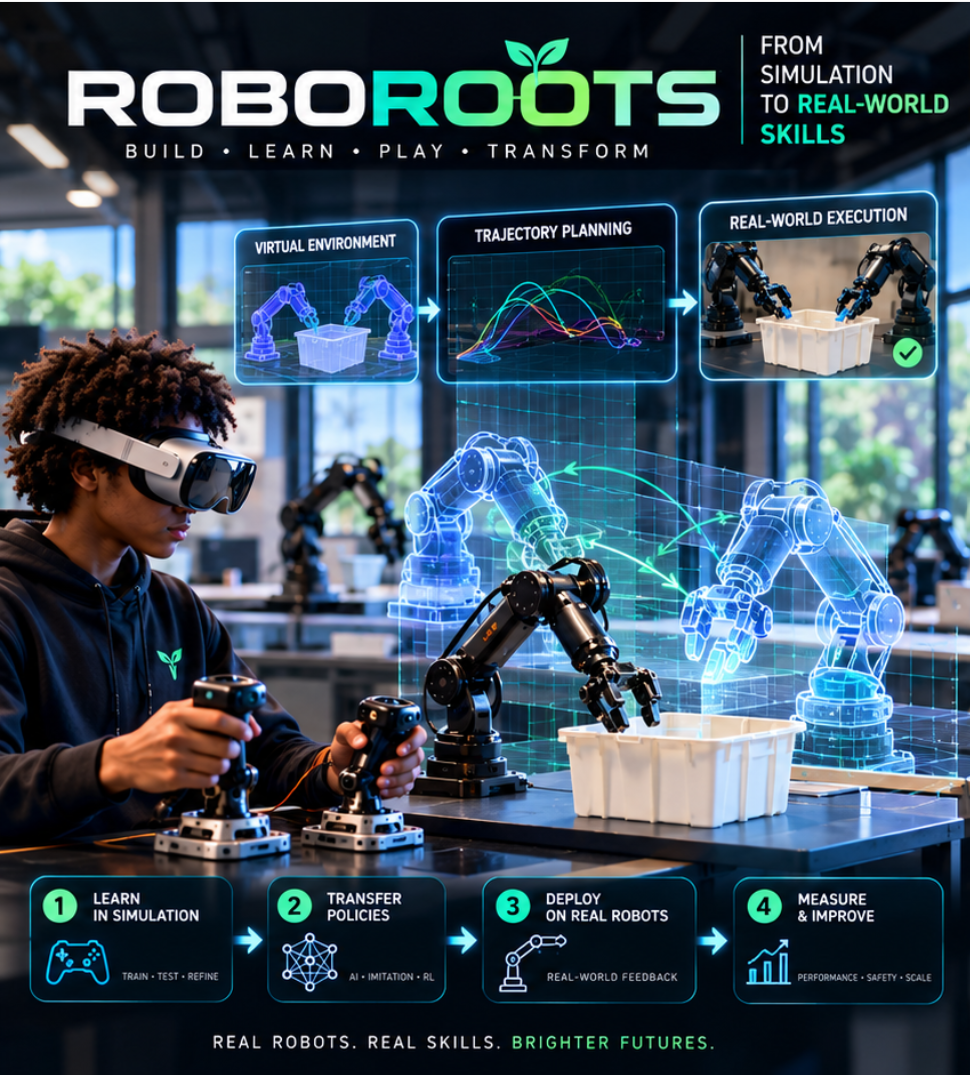
Before a single policy touches physical hardware, it is forged in simulation. We build a digital twin of the SO-101 and its workspace, then use NVIDIA Isaac Lab to run thousands of parallel physics-accurate episodes — domain-randomizing lighting, friction, and object pose so the learned behavior generalizes rather than memorizes. On this foundation we compile an ACT (Action Chunking Transformer) policy, training it against the teleoperation demonstrations and refining it with reinforcement in the simulator. Cloud training runs through Seeed's SenseCraft infrastructure, so cohorts without local GPUs can still iterate on state-of-the-art imitation-learning pipelines.
//Fig 2: The Sim-to-Real Pipeline — Training Trajectory Policies in Physics Simulators Before Physical Deployment.
Autonomous Real-World Inference
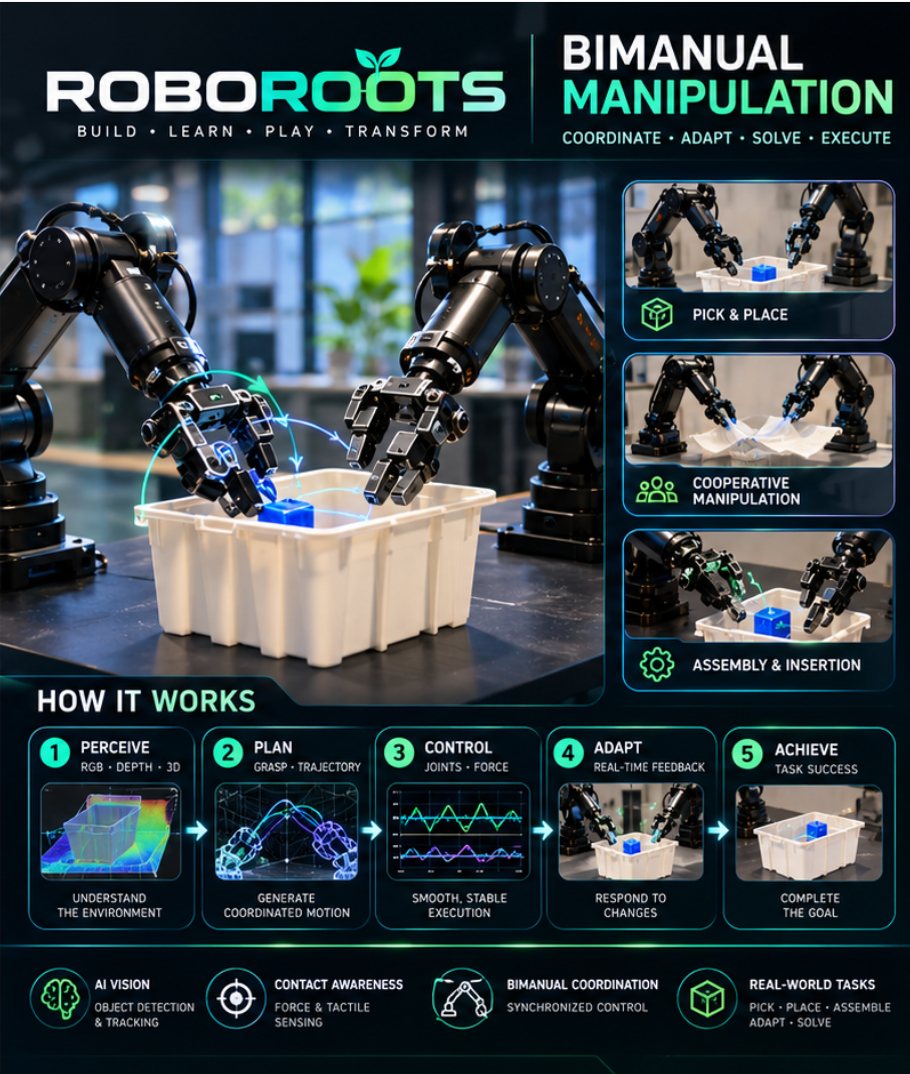
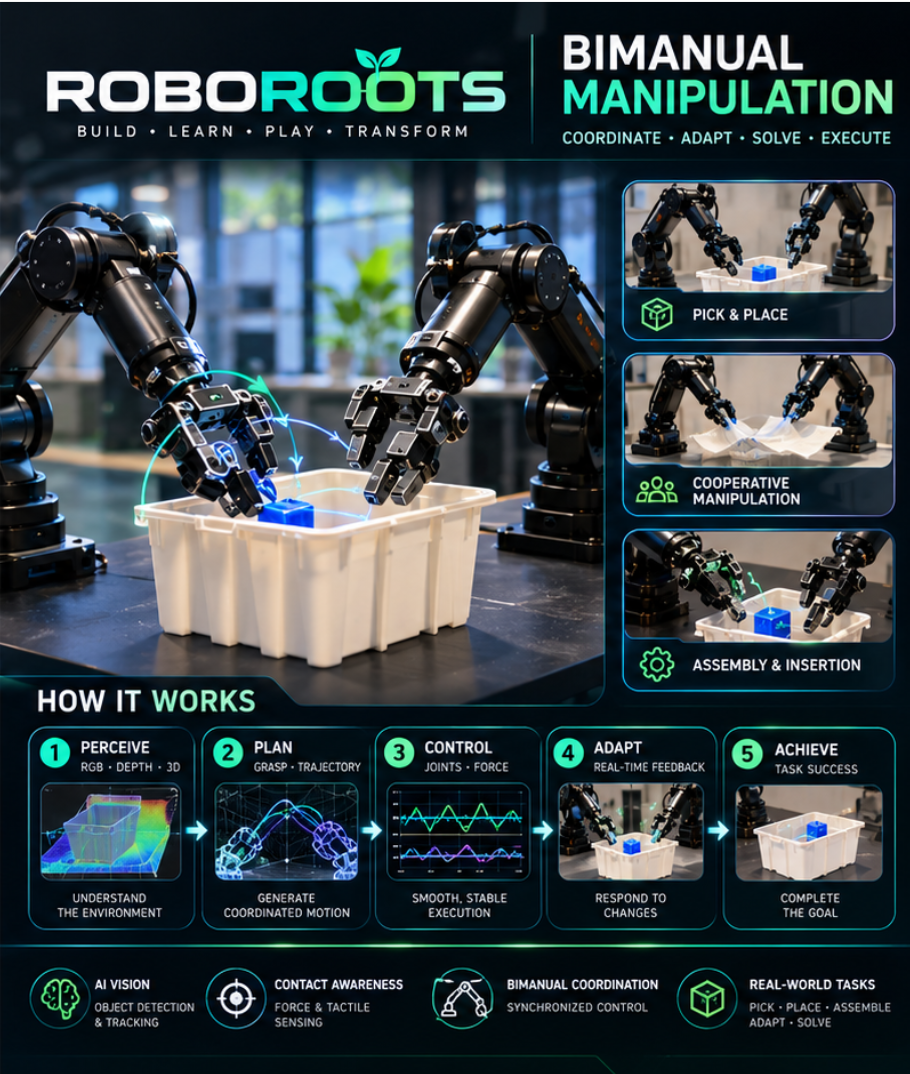
The moment of truth is deployment. The trained policy is exported to the edge computer on the Seeed follower arm, where it runs closed-loop at real-time rates: the cameras stream observations, the transformer predicts the next chunk of joint actions, the servos execute, and the loop repeats dozens of times per second. Because the servos report live load, the system exhibits genuine tactile adaptation — it senses contact, compensates for a cube that shifted, and recovers from a grasp that slipped, rather than blindly replaying a fixed trajectory. This is the leap from scripted automation to operational intelligence: a machine that adapts to the world as it actually is.
//Fig 3: Bimanual Coordination & Contact Awareness in Real-World Manipulation.
The Leap to Quadrupeds and Humanoids
Here is the insight that makes the tabletop arm so powerful as a teaching platform: the mathematics does not change as the robot grows. The forward and inverse kinematics, the perception-plan-control-adapt loop, and the sim-to-real policy pipeline a student masters on a 6-axis arm scale directly to a mobile quadruped navigating rough terrain and to a 30-DoF bipedal humanoid coordinating two arms, a torso, and a walking gait. A humanoid is, in essence, a locomotion system with several manipulators bolted on — and every one of those manipulators is governed by the very principles learned on the SO-101. Master the joint, and you have begun to master the embodiment.
What Comes Next
In the next installment of this series, we take exactly that leap — moving off the tabletop and onto the floor as we bring these policies to autonomous quadrupeds and full-scale humanoids, and show how a cohort of youth builders can teach a walking robot to manipulate its environment. But the technology is only half of the mission. As embodied AI moves from the lab into our streets, homes, and workplaces, the most urgent curriculum is technological literacy for the next generation — fluency not only in how these systems are built, but in how they are governed, secured, and deployed safely. The communities that understand this technology will shape it. RoboRoots exists to make sure our young people are among them.
Official Technology Partner: Seeed Studio — The AI Hardware Partner
RoboRoots is proud to partner with Seeed Studio to equip our youth cohorts with open-source SO-101 robotic arms, SenseCraft cloud compute infrastructure, and industrial edge AI hardware.