01The Lab Prototype That Crashed an Industry
Every revolution in physical artificial intelligence begins not in a multi-billion-dollar corporate boardroom, but at a workbench strewn with burnt solder, exposed wiring, and unproven mechanical calculations. In 2013, while pursuing his master's degree at Shanghai University, a young mechanical engineering student named Wang Xingxing found himself obsessed with a problem that had stalled global robotics for decades: why are walking machines so prohibitively expensive and fragile? At the time, legged locomotion was virtually monopolized by academic labs and industrial research titans like Boston Dynamics, whose hydraulic quadrupeds cost well over six figures and required complex, high-maintenance hydraulic power packs. Armed with a modest budget of roughly $1,500 to $3,000, Wang bypassed industrial gearboxes and hydraulic pumps altogether. Instead, he pioneered an architecture built on high-torque brushless DC motors and lightweight quasi-direct-drive (QDD) actuators. The result was XDog, a scrappy, table-built four-legged runner that proved dynamic balance could be achieved with consumer-grade electronics.
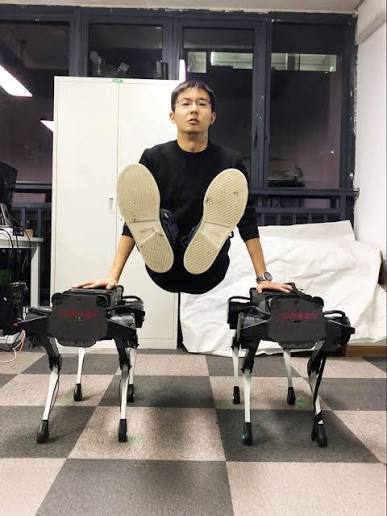
Founder file // Wang Xingxing
Wang performs a parallel-bar hold on two early Unitree quadrupeds, a stress test of torque, balance, and confidence in his own actuators.
Born 1990 • Ningbo • Shanghai University M.Eng • ex-DJI • Founder & CEO, Unitree Robotics
02The Founder's Journey: Turning Curiosity Into Momentum
Wang Xingxing's path underscores a fundamental truth for young builders: academic metrics do not define your engineering ceiling. Born in Ningbo in 1990, Wang openly struggled with standard classroom language exams, but possessed an instinct for mechanical spatial logic and physical problem-solving. After graduation, he took an engineering role at drone giant DJI in Shenzhen, immersing himself in the precision manufacturing ecosystems of the Pearl River Delta. However, when a short video clip of his university XDog prototype unexpectedly went viral across global robotics laboratories in mid-2016, Wang recognized a historic inflection point. Walking away from corporate stability, he launched Unitree Robotics in Hangzhou with just $275,000 in angel capital. Driven by an obsession with mechanical elegance and affordable motor torque, Wang spent his earliest startup years sleeping near CNC mills and tuning firmware, determined to turn a solo master's thesis into a scalable global manufacturing powerhouse.
Scrub evolution timeline [2016 – 2026]
Drag the bar or tap a year
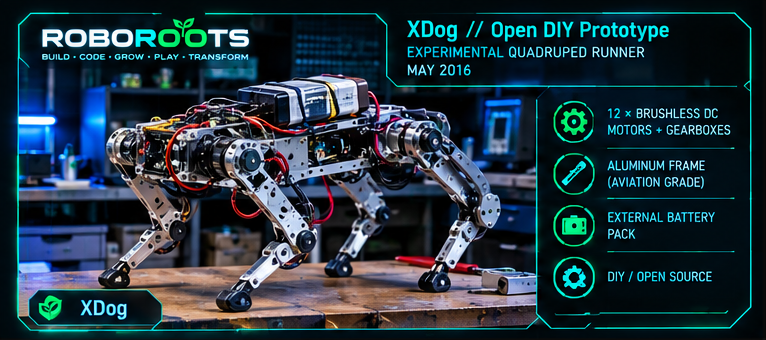
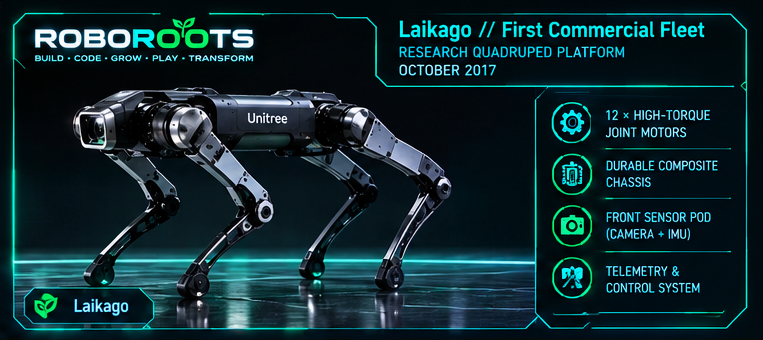
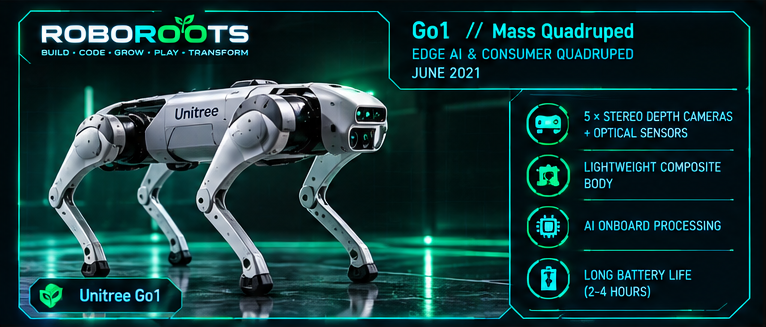
2016 // Experimental Quadruped Runner
XDog
- Degrees of Freedom
- 12 DoF (3 per leg)
- Max Velocity
- Dynamic trot / bounding gait
- Primary Compute / AI Pipeline
- Hand-tuned embedded control loops
- Key Engineering Innovation
- Brushless DC motors + gearboxes replace hydraulic power packs
Playbook breakthrough
Proved dynamic balance was possible on a student budget with consumer electronics.
03The DJI Playbook: From Drones to Bipedal Humanoids
To understand Unitree's rapid ascent, builders must examine the “DJI Playbook,” the structural bridge connecting consumer drone supremacy to modern robotics. A decade prior, DJI transformed aerial robotics by solving the core hardware bottleneck: mass-producing affordable flight controllers, brushless gimbal motors, and integrated camera feeds, converting a hobbyist novelty into an indispensable industrial tool. Wang Xingxing recognized that legged robotics suffered from the exact same dynamic. Legged robots were simply drones with articulated legs instead of propellers: both are multi-variable stabilization machines governed by high-frequency sensor loops, gyroscopes, and brushless motor current limits. Rather than chasing high-margin defense or proprietary corporate contracts, Unitree manufactured affordable, reliable hardware directly for university researchers, hobbyists, and community labs. By releasing platforms like the A1 and Go1 (crashing prices from $75,000 down to $2,700), Unitree transformed global research labs into their personal developer ecosystem. Researchers worldwide wrote their locomotion policies on Unitree motors, creating an inescapable software and hardware flywheel that funded the tooling for the humanoid era.
04The Architectural Leap: Repurposing Motors for Bipedal Balance
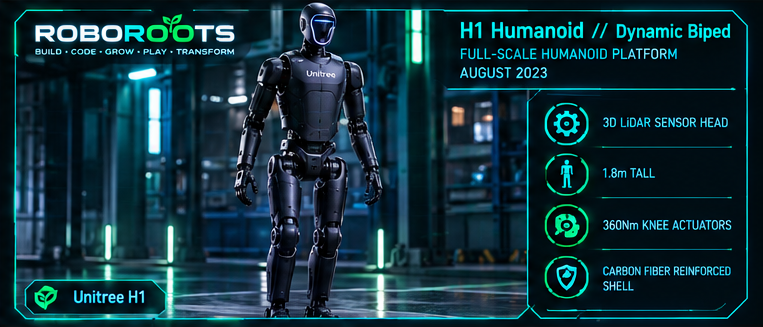
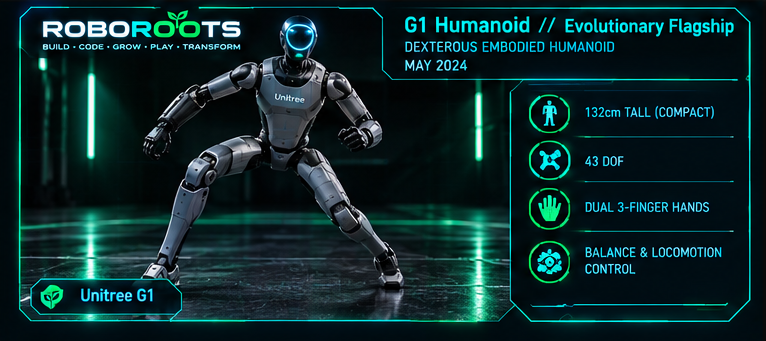
By late 2023, Unitree leveraged the high-torque actuator supply chains built across hundreds of thousands of quadruped dog limbs to launch into bipedal humanoids. The 1.8-meter Unitree H1 demonstrated record-shattering sprint speeds and backflips powered by 360 Nm joint actuators. This paved the way for the Unitree G1 in 2024: a 132 cm, 35 kg humanoid priced disruptively at $16,000, equipped with dexterous robotic hands and trained via deep reinforcement learning and imitation policies. Where legacy western robotics firms spent decades hand-tuning deterministic physics equations, Unitree leaned into the modern Physical AI paradigm: utilizing digital twin environments like NVIDIA Isaac Sim and Isaac Lab to train dynamic whole-body neural controllers across thousands of parallel instances before flashing the weights straight to the robot's edge compute nodes.
Chassis anatomy // Unitree G1
Drag the handle to reveal the internals
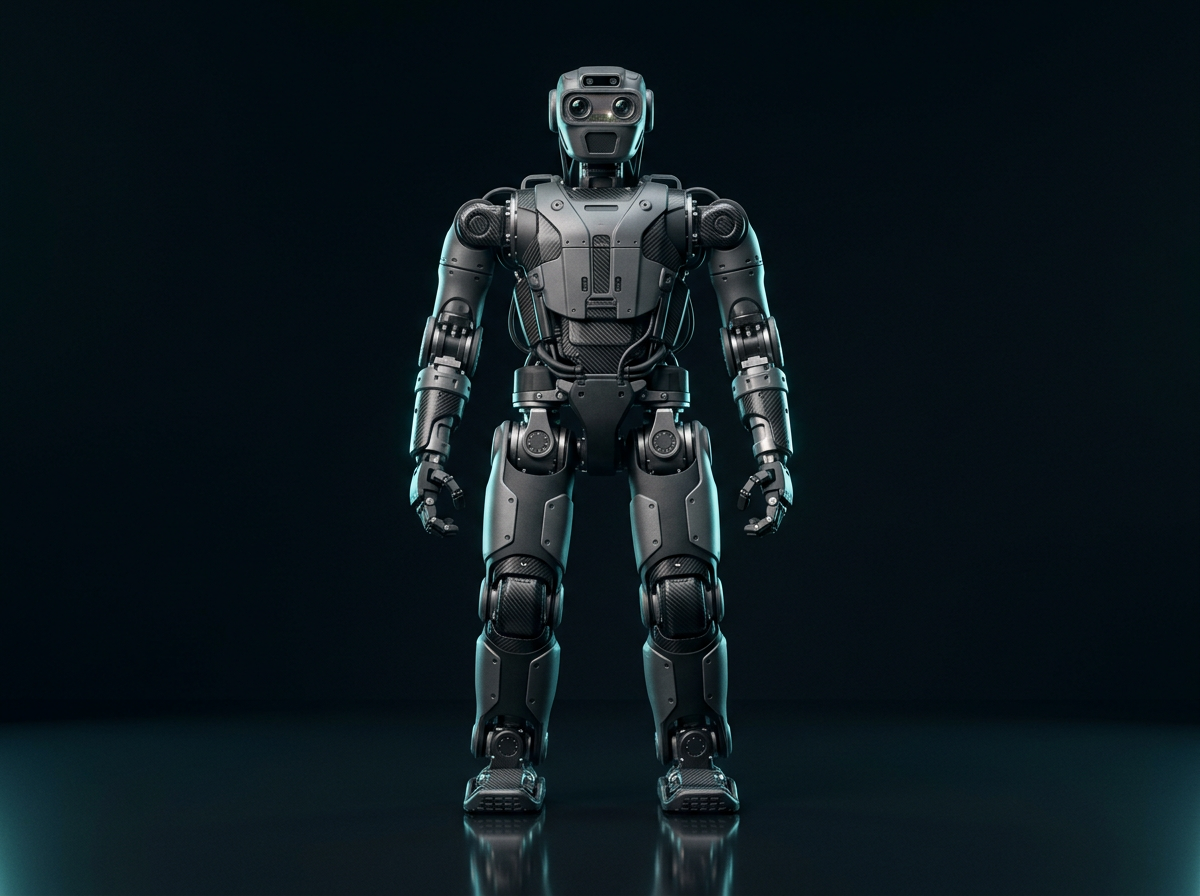
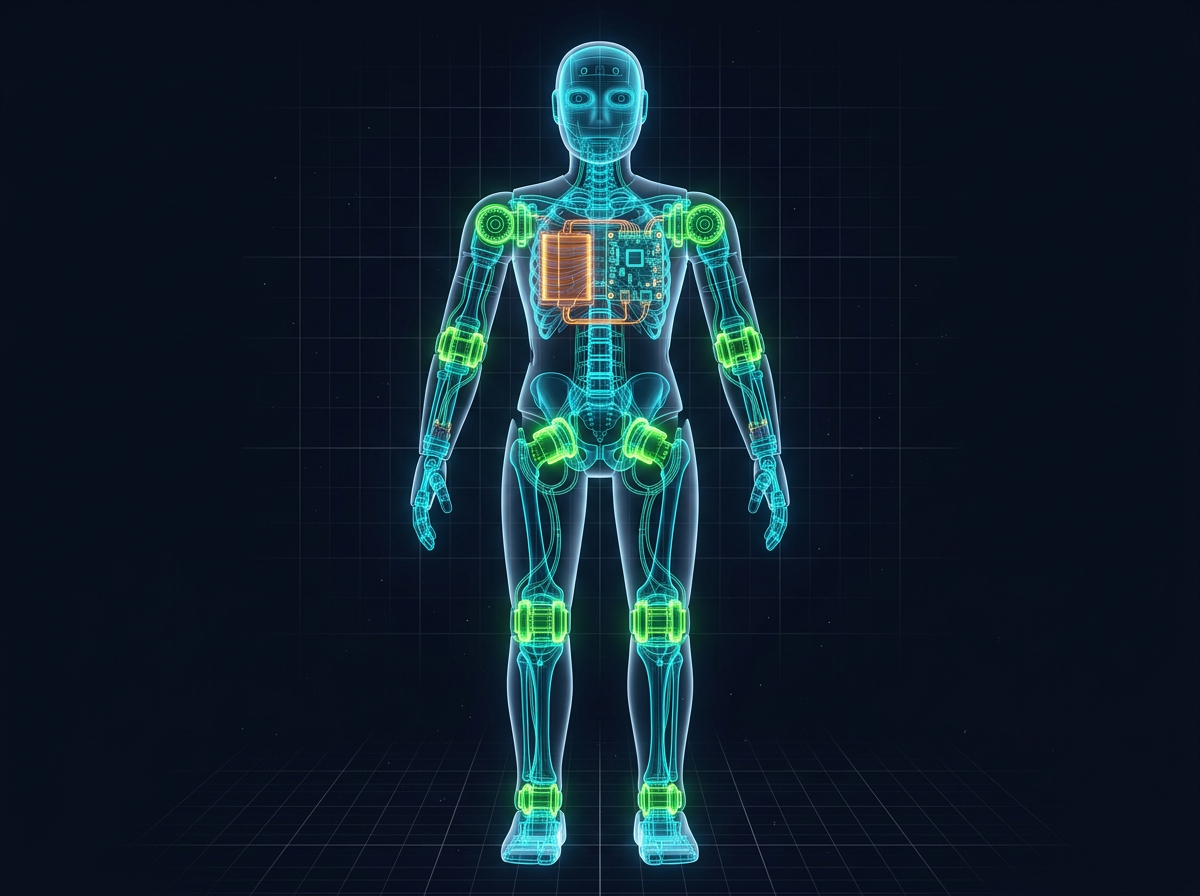
Hardware De-Abstraction: What appears to be an impossibly complex humanoid is fundamentally a network of bus-addressed servos, harmonic gearboxes, and edge microcontrollers. Master the joint, master the machine.
05Scale, Embodied AI, and the GD01 Horizon
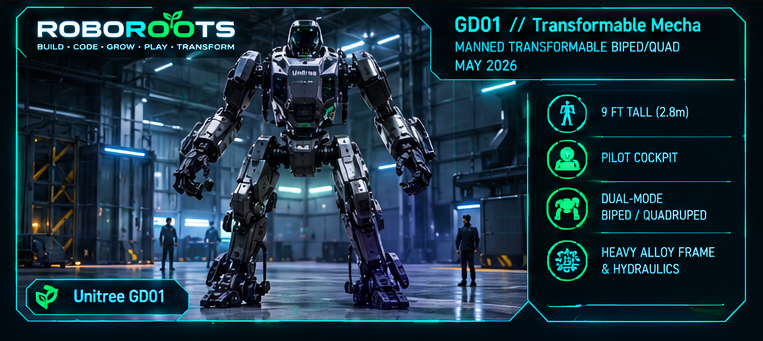
By August 2026, Unitree completed a historic initial public offering (IPO) on Shanghai's STAR Market, raising over $900 million at a valuation exceeding $8 billion to $9 billion. Today, their research spans from the ultra-compact R1 STEM learner humanoid ($5,900) to the full-size H2+ reference platform co-developed with NVIDIA for the GR00T embodied foundation model ecosystem. Pushing the absolute boundary of mechanical imagination, Unitree unveiled the GD01, a 9-foot-tall, 500-kilogram manned, transformable mecha vehicle inspired by science fiction, capable of switching between a bipedal stance and a quadrupedal crawler mode with an onboard human pilot. Simultaneously, Unitree is deploying “self-evolving physical AI” architectures, allowing frontier reasoning models to analyze robotics research papers, write low-level motor control C++ code, and benchmark policies autonomously inside simulation containers.
Spec comparison matrix // Unitree G1 vs. industry standards
| Specification / Metric | Unitree G1 (Disruptive Commercial) | Tesla Optimus Gen 2 | Figure 01 / 02 |
|---|---|---|---|
| Form Factor / Height | 127 cm | 173 cm | 170 cm |
| Weight | 35 kg | 57 kg | 60 kg |
| Degrees of Freedom | 23–43 DoF | ~28 body + 11–22 hands | ~38–41 DoF |
| Max Speed | 7.2 km/h + dynamic flips | ~8.0 km/h | ~4.3 km/h |
| Commercial Cost | $16,000 (accessible) | Not for sale / ~$25k target | Enterprise lease only |
| AI Training Pipeline | NVIDIA Isaac Sim / Imitation Learning | Tesla FSD neural net | OpenAI / Helix VLA |
// Figures reflect publicly reported specifications and may vary by configuration.
06Overcoming Hurdles: Sovereignty, Supply Chains & Heat Dissipation
Yet the journey of high-velocity hardware is never frictionless. Wang Xingxing's venture has faced severe engineering bottlenecks: high-torque compact motors produce immense thermal heat during continuous dynamic loads, while dexterous manipulation data remains scarce compared to locomotion data. Furthermore, geopolitical turbulence and legislative frameworks like the U.S. GUARD Act have highlighted the precarious nature of international technology dependencies. For grassroots builders, these challenges carry a vital lesson: hardware access cannot be treated as a passive consumer product. True technological resilience requires that communities master mechanical fundamentals, understand actuator physics, and learn how to harvest local teleoperation datasets so that domestic innovators can design, build, and maintain their own robotic fleets.
07Swim to the Future: Driven by Innovators in STEM
The story of Unitree and Wang Xingxing is not merely a corporate case study; it is an urgent invitation to the next generation of youth builders. Ten years ago, the actuators that drive humanoids were considered an impossible, state-secret engineering challenge; today, they are accessible modular components that can be studied, improved, and reinvented in neighborhood innovation labs. When you master joint kinematics on a tabletop robotic arm at RoboRoots, you are holding the exact mathematical blueprint that moves a 30-DoF humanoid or an agile quadruped through the physical world. Do not stand on the shoreline waiting for the future of automation to be delivered to your doorstep. Step into the arena, deconstruct the machine, write the code, and swim boldly into the future driven by innovators in STEM.
Primary sources // Watch the story
 Visit Unitree Roboticsunitree.com(opens in a new tab)